92 Main St, Ashland, ME 04732 Phone: (207) 435-6213 Contact Us

Experience the Tradition of the North Maine Woods!

Experience the Tradition of the North Maine Woods!

Experience the Tradition of the North Maine Woods!

Experience the Tradition of the North Maine Woods!

Welcome to North Maine Woods

NMW is one of Maine's most unique regions which provides remote recreational opportunities and supports our natural resource based economy. In this magazine, you'll find tips for a safe trip and learn more about forest resource management.

Welcome to the North Maine Woods - Multiple Ownership - Multiple Use Management Area. The private forest landowners and state governmental agencies cooperating in this program are pleased you have chosen to visit our web site. It is designed to help you have a safe and pleasant trip in the area, plus provide you with valuable information on forest resource management and recreational use.

The area provides numerous outdoor recreational opportunities for over 100,000 visitors each year while at the same time providing renewable forest resources which are a major part of Maine's economy. Harvesting wood products and providing recreation are compatible if managed properly. Providing proper management of day use and camping is the main goal of the North Maine Woods organization.

Maine Spruce Budworm Task Force

The SBW Task Force is a joint effort of the Maine Forest Service, Maine Forest Products Council, and University of Maine's Cooperative Forestry Research Unit along with leading experts on the SBW

CURRENT POSTINGS & ROAD CONDITIONS

Pinkham Road closed Monday July 13- Monday July 27th

The Pinkham Road at South Branch bridge will be closed to install a new bridge at South Branch Crossing.  The Pinkham Road will be closed for two weeks to install the new bridge.  Trucks can go through Spectacle Pond Road to the Jack Mountain Rd if needed for off highway/pickups or across the 20 mile Road for on highway/pickups. 

NEW REQUIREMENT FOR TENT CAMPS

Outfitter Outpost Permit

In recent years, there has been a growing interest from commercial outfitters in establishing seasonal “tent camps” to better serve their clients. During the Maine moose hunting season, facilities and services are not readily available in the remote North Maine Woods. This increases the need for professional guide service along with accommodations, especially in wildlife management zones 1,2,4, and 5. At the same time, landowners in the North Maine Woods want to ensure that families will have space to enjoy their recreational experience as well.  

Therefore, North Maine Woods staff are working in cooperation with landowners, Professional Maine Guides, and Maine Department of Inland Fish & Wildlife’s Landowner Relations program to host a second year of the Outfitter Outpost pilot project. The guidelines are below.

Application process:

  • Outfitter applies annually to NMW for an outpost using the application form which includes the necessary criteria.
  • When submitting the application, the applicant must include a plan for waste disposal.
  • NMW contacts the landowner for review of the application and approval/denial. Some landowners may choose not to participate in this program.
  • NMW contacts the outfitter with the results.
  • The outfitter operates the site for no more than 90 days and must vacate the site concurrent with the closure of the NMW checkpoints.
  • The outfitter will be responsible to follow all stipulations on the application. The outfitter is solely responsible for all activities and environmental responsibilities associated with the location, which must be conducted in accordance with Maine rules and regulations.

Conditions for approval of temporary outposts include:

  • Outfitters must obtain a commercial use permit from North Maine Woods and follow all NMW rules including checkpoint fees.
  • The responsible outfitter must be a Registered Maine Guide and hold appropriate insurance.
  • All parties visiting temporary outposts must pay the customary registration fees and follow all NMW rules.
  • Outfitters must abide by all State & Federal laws, including fire permits.
  • Outfitters must abide by and take full responsibility for complying with LUPC & DEP rules. (https://www.maine.gov/dacf/lupc/laws_rules/ch10.html), including gray and black water disposal.
  • Structures built such as buildings or tent platforms are prohibited.
  • The outfitter is to remove all tents/campers and associated items, including litter, before the closing of the NMW checkpoints in mid-November.
  • A sign will be posted at the entrance to the temporary outpost indicating the name of the outfitter and GPS coordinates.
  • The temporary outpost will not block any roads or restrict access for others.
  • The temporary outpost will not conflict with logging or road construction operations.
  • Each campsite location requires a separate application.
  • Applications must be submitted to North Maine Woods Inc.
  • This agreement does not establish rights for the following year.
  • “All parties camping in traditional NMW authorized campsites are limited to a 14-day stay per North Maine Woods policy.”

Please contact North Maine Woods for an application.

Driving Safely on Woods Road

All roads within the North Maine Woods are privately built and owned primarily for the purpose of managing and moving forest products.
The private landowners are willing to share their roads with members of the general public in order to visit the region’s many lakes and ponds and other natural resources.

ALL LOGGING TRUCKS AND OTHER COMMERCIAL VEHICLES
HAVE THE RIGHT OF WAY.  PLEASE PULL OVER WHEN MEETING THESE VEHICLES.

  • Travel with extreme caution on all logging roads.
  • Travel at posted speeds but no more than 45 miles per hour.
  • Use a MURS radio to monitor and call out mile markers to on-coming truck traffic
  • Keep to the right when approaching a corner or cresting a hill.
  • When approaching active equipment near the roadside wait for acknowledgement from equipment operators before proceeding to pass.

Thank you!!!


GPS-enabled Dog Tracking Systems are Creating a Safety Concern for Landowners.  Corrective Action is Required for these Devices to be Allowed Use Within the NMW Region.

If you are using a GPS-enabled dog tracking device such as the Garmin Astro or Garmin Alpha tracking system, be advised that the collars for these systems operate on the same MURS (Multi-Use Radio Service) frequencies used by logging trucks for monitoring road traffic.  These collars create audible interference on truck radios that are within range of a collar operating on the same MURS frequency (i.e. channel).  The 5 frequencies used by the MURS radio and Garmin systems are:

MURS Channel 1 = 151.820 Mhz / MURS Channel 2 = 151.880 Mhz / MURS Channel 3 = 151.940 Mhz

MURS Channel 4 = 154.570 Mhz / MURS Channel 5 = 154.600 Mhz

The first four frequencies (channels 1-4) are used primarily for monitoring road traffic with each road system in the NMW region being assigned a specific MURS channel.  MURS Channel 5 has been designated as an acceptable channel for dog collars to operate on.

It is important that you make sure your dog(s) collars are operating on MURS channel 5, and by no means should a collar be operating on a channel used by the road system you are hunting or traveling on.  To check what channel your dog’s collar has been programmed to operate on, you will need to check the channel number (Alpha system) or Dog ID (Astro system) assigned to the collar by using the following information:

ALPHA SYSTEM:  The first number of the Alpha channel (followed by a Dash Number) indicates which MURS channel the dog collar is using.  For example:  3-29 indicates MURS channel 3 is being utilized, 1-18 indicates MURS channel 1, 2-7 is channel 2, etc.  Therefore anyone using the Alpha system should have a 5 as the first number for that collar.

ASTRO SYSTEM:  The Astro system assigns an ID number (0-49) as opposed to using a channel number like the Alpha system, but the MURS frequency can be determined from the ID number by using the following chart:

Dog ID Number 0-9 (151.820 Mhz)       =   MURS Channel 1
Dog ID Number 10-19 (151.880 Mhz)   =   MURS Channel 2
Dog ID Number 20-29 (151.940 Mhz)   =   MURS Channel 3
Dog ID Number 30-39 (154.570 Mhz)   =   MURS Channel 4
Dog ID Number 40-49 (154.600 Mhz)   =   MURS Channel 5

Collars that are not operating on the proper channel will need to be manually assigned to channel 5 (Alpha) or a Dog ID Number from 40 to 

49 (Astro).  Please consult your owner’s manual on how to do this manually or contact the NMW office (435-6213) for assistance. 

How to change Dog ID on Garmin Alpha tracking collars
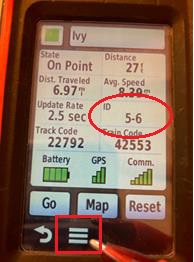
Garmin Alpha Interface

Turn on both collar and handheld. Collar must be paired with handheld to change ID

Select “Dog List”
Select dog/collar in question
Select “Show Info”
On this screen one of the boxes will say ID and have a number like 2-3, 1-25, etc. If the collar does not have an ID starting with 5-…, then it needs to be changed. Garmin collars transmit on MURS channels so 1-4 correspond to MURS channels 1-4 used for communication and safety on logging roads.
Select the 3 bars at bottom menu on the screen.

Select “Change ID”
Scroll to a 5-… number and select. Keep in mind to not choose same ID as hunting partners or other dogs in hunting party, there are about 20 options under the 5 codes.
When ID is changed unit will say “Dog (or dog name) collar is set”, press OK
Your tracking collar is now set to a frequency that will not interfere with communication used by truck drivers for road safety.

Maine Moose & Winter Ticks

(Click on link below for information and current status of Maine’s moose population)
https://www.maine.gov/ifw/fish-wildlife/wildlife/species-information/mammals/moose-winter-ticks.html
ARE YOU LOOKING FOR A JOB?

Check out the surrounding area weather before your trip!